Add Listing
  • You have no bookmark.

Your Wishlist : 0 listings

Sign In

Maasai village day trips

A lot of us have grown up watching documentaries about the African wild on National Geographic or Discovery channel. Whenever the cameras descend into the plains of East Africa, one warrior tribe dressed in brilliant reds and blues, almost always pops up on screens – the Maasai.

These semi-nomadic pastoralists live in/around the rift valley region of Northern Tanzania and Southern Kenya. On your safari trip, as you drive towards the national parks in this region, you will see the colorful maasai herding their cattle or trying to sell you their artwork.

But did you know you can also visit their village on your safari tour and interact and get a glimpse into their unique culture, customs and practices ? If that sounds interesting, read the entire article to know more about what to expect on a Maasai village tour and see if you would like to add one to your itinerary.

Maasai Village Experience

Maasai Village Tours occur in multiple locations.

Ngorongoro Crater Rim This is the most frequently visited Maasai village. Easily accessible by clients visiting Ngorongoro for crater tours or just passing through Ngorongoro to get to Serengeti. Also the most scenic of all, given its location on the crater rim. However this can feel more staged and the Maasai here have more pushy sales approach compared to other villages

The region near Lake Natron has its own Maasai village, and the tours here are accessible for clients visiting Lake Natron as a part of their itinerary. The maasai villages you visit here are permanent (while at many other locations, Maasai tours happen in villages where people rotate from time to time to share revenue earned from doing these tours for clients) and this visit feels more authentic compared to other locations. You will get a chance to see how the cows are milked, witness the mudding of Maasai houses, see how they construct their stoves and get a chance to take part in these activities too. You can also spend longer hours (like upto 6 hours) on Maasai village tour here.

Other Maasai villages can be found near Mto Wa Mbu, Tarangire, Arusha, Mikuni National Park, Serengeti-Ngorongoro border, and Moshi. These villages are mostly located on the way to important sites such as Tarangire National Park, Arusha National Park etcetera. If the clients cannot find the time to visit the villages in the crater rim or near Lake Natron but still desire to see a Maasai village, they can visit these locations.

A visit to the Maasai village usually takes around one to one and a half hours for which you are expected to tip $25 (per client) to the Maasai village head. This money will not be collected by us (Monkey Adventures) and we request you to directly hand it over to the village head.

However, if you wish to spend a longer time at the village then that can be arranged too. For a longer visit please check with your sales consultant.
A64F2568-8F33-4023-91FE-F00CA1C7D62C

There are three kinds of Maasai village. One is a roadside ‘village’ that has been set up to introduce passing tourists to Maasai culture and traditional life. Some of these are excellent, replicating both the architecture of a genuine Maasai village and with cultural performances that illustrate some aspects of Maasai traditional life. Others are tourist traps that bear little resemblance to Maasai tradition and where the main purpose is to extract money. Make sure that your tour operator is taking you to the former.

A second form of Maasai village is a modern village where the majority of people are Maasai. These are found in the areas around Amboseli National Park and the Masai Mara National Reserve, and many offer homestays with Maasai families. While these are not traditional Maasai villages, some are excellent and offer a wonderful (and thoroughly authentic) window on modern and traditional Maasai life.

The third kind of Maasai village is the traditional manyatta. These are fenced, roughly circular enclosures out on Maasai grazing lands, which are always outside the national parks and reserves (but they may lie within the conservancies in the Amboseli and Masai Mara areas). The central open area is for cattle to stay at night to protect them from predators, with basic rooms around the perimeter where the Maasai sleep. The cattle are let out to graze early each morning, and they often roam far from the manyatta, before being corralled back inside at night. This is the most traditional form of a Maasai village.

You should try and spend as long as you can in the village: a flying visit that lasts long enough to take some photos and leave is unlikely to make either party feel as though they’ve had a genuine or meaningful encounter. 

Take the time to sit down and talk with your Maasai hosts, and don’t take out your camera immediately. Always ask permission before taking photos. 

The best encounters are those where neither party feels as though they have to perform, and where both parties learn something about each other. Above all, treat your hosts with respect, do a little research before you visit, ask questions and always listen to the answer.

The best time to visit a Maasai village is during the Dry season, which, in Maasailand, runs from June to October. During the Wet season, it can be difficult to get off-road to where the manyattas are located, and conditions are generally more difficult after rain. 

If you are able to visit a manyatta, they can be quite empty during the day as the cattle graze and the community goes about its business of herding, gathering water and so on. Manyattas are best visited in the early morning and late afternoon when they’re busy community hubs.

The Maasai have their origins in Kenya’s arid north, probably in the area around Lake Turkana and then Laikipia. From the 15th century onwards, they swept down through the Great Rift Valley in search of better grazing land for their cattle. By the 17th and 18th centuries, the Maasai had established themselves in what we now know as southern Kenya and northern Tanzania.

In the late 19th century, they resisted the encroachment of British soldiers and settlers. But devastating epidemics of smallpox and cattle-borne diseases weakened their ability to maintain control over their land. In the middle of the 20th century, the colonial authorities in both Kenya and Tanzania began to establish national parks, forcing many Maasai communities from their lands. 

These parks included Amboseli National Park and the Masai Mara National Reserve. It was only later in the 20th century that the Maasai regained access to many of their traditional lands, and took on an active role in safari tourism.

The Maasai inhabit what is known as Maasailand, a region that extends across southern Kenya and northern Tanzania. In Kenya, the Maasai homeland takes in the Chyulu Hills, Amboseli, Lake Magadi and west to the Masai Mara National Reserve and the Maasai-run community conservancies that surround it. In Tanzania, the traditional Maasai realm extends from the eastern Serengeti and Ngorongoro, across the Crater Highlands through Lake Manyara and Tarangire to the foothills of Mt Kilimanjaro.

Traditionally, a young Maasai man had to kill a wild lion using a spear in order to gain the respect of his peers and demonstrate his readiness to become a warrior. Although this tradition continues in some areas, falling lion numbers and a ban in Kenya on all forms of hunting have significantly reduced this practice.

The Maasai have traditionally had (and, in many cases, still have) a strict social structure. Maasai women are very often restricted to roles as wives and mothers, but are considered bastions of strength and stability within their communities. This is slowly changing, especially with young women becoming more involved in tourism. Elders occupy positions of great respect in Maasai communities. Cattle are the foundation of Maasai life, and the wealth and status of a Maasai family is most often calculated based on the number of cattle owned. A traditional Maasai meal consists of blood and meat.

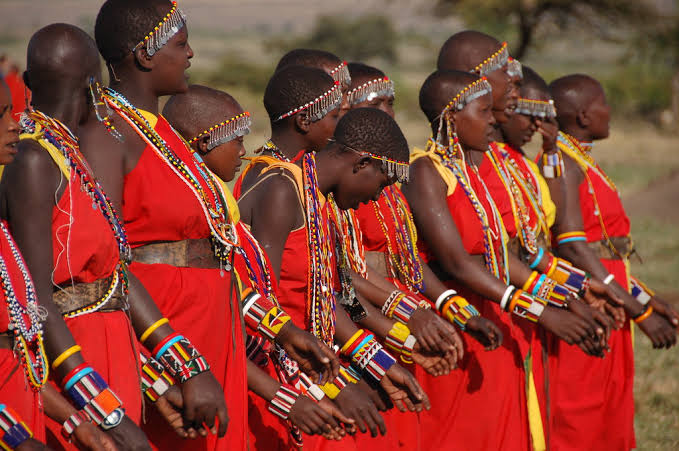
The Maasai remain one of the most traditional of all East Africa’s peoples. While those Maasai who have migrated to the city usually wear non-traditional clothing, men who still lead traditional lives are almost universally draped in the blood-red-checked shuka (cotton blanket). 

They also often wear beaded bracelets and other adornments. Many Maasai women also wear a version of the shuka, as well as circular, plate-like necklaces made of beads.

Maasai Village day Trips

OTR

Our wonders are everywhere .....